Ultra-High-Molecular-Weight Polyethylene (UHMWPE): Properties and Performance
Published by
PBY Plastics
on
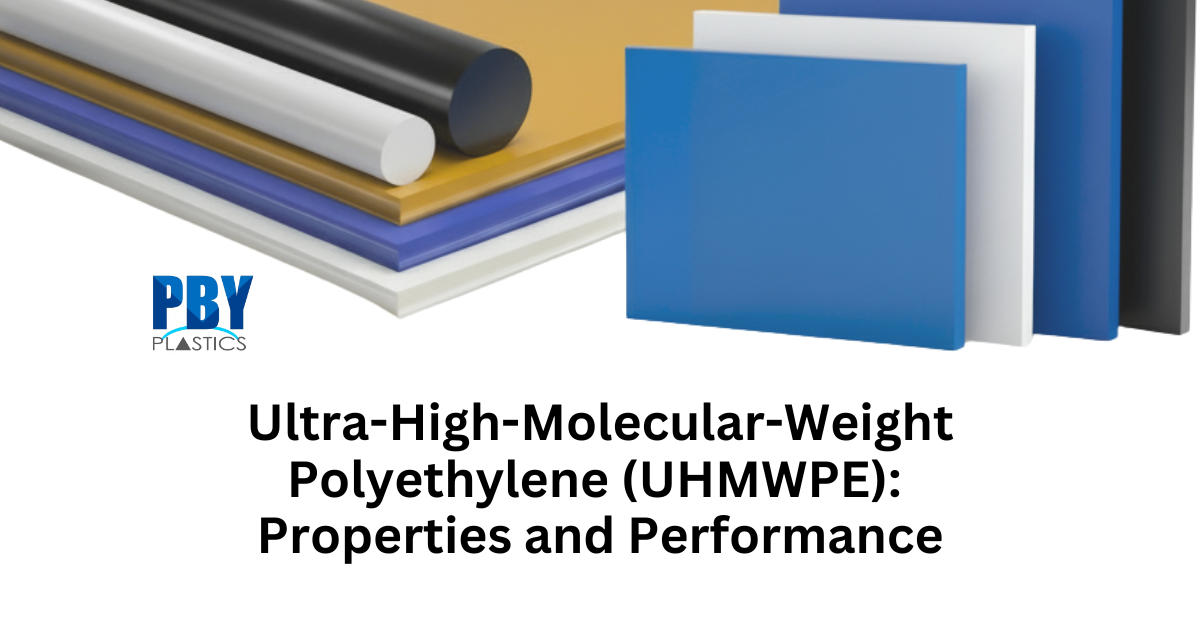
Introduction to UHMWPE and its Fundamental Properties
UHMWPE is an ethylene monomer-based homo-polymer classified as a linear and semi-crystalline polymer. It differs from high-density polyethylene (HDPE) due to its extremely long polyethylene chains and greater average molecular weight. According to the International Standards Organization (ISO), UHMWPE must have a molecular weight of at least 1 million g/mole. The American Society for Testing and Materials (ASTM) specifies a molecular weight greater than 3.1 million g/mole. The molecular weight typically ranges from 6.7×10⁶ g/mol to 1.02×10⁷ g/mol.
The widespread impact of UHMWPE in the medical field stems from its exceptional suite of bio-tribo-mechanical attributes, which include:
- Excellent Wear Resistance and Low Friction: These properties are critical for bearing surfaces. The material exhibits a high level of wear resistance and a low coefficient of friction (0.12–0.15 in dry conditions).
- Mechanical Robustness: It possesses high toughness, high impact strength (significantly higher than HDPE), and high ultimate tensile strength (ranging from 5500 to 7000PSI).
- Biocompatibility and Chemical Inertness: UHMWPE is well-regarded for its biocompatibility and chemical inertness, making it highly suitable for long-term implantation.
- Structure: It is a linear, semi-crystalline polymer. Its physical characteristics, such as ductility and high crystallinity (which can exceed 90% in highly oriented fibers), are highly dependent on its microstructure.
Strategies for Functionalization and Performance Enhancement
UHMWPE stands as the material of choice for bearing surfaces in biomedical applications and has been utilized since the 1960s. Ongoing endeavors seek to balance UHMWPE properties by tailoring processing techniques and modulating microstructural features.
The Role of Crosslinking and Additives
Crosslinking, commonly achieved through irradiation, is typically implemented to improve the wear resistance of UHMWPE. However, increasing the degree of crosslinking decreases the fatigue threshold (ΔKth) and reduces fatigue crack propagation resistance. Highly crosslinked materials exhibit lower crack thresholds compared to formulations with little or no crosslinking.
To mitigate oxidative degradation, particularly after irradiation, antioxidants such as Vitamin E (ɑ-tocopherol), Gallic Acid (GA), and Dodecyl Gallate (DG) are introduced. Vitamin E stabilizes UHMWPE by reacting with trapped free radicals, preventing them from reacting with oxygen, thereby increasing resistance to wear and fatigue. Modern implants often use moderately cross-linked UHMWPE remelted with Vitamin E to achieve a balanced performance profile. Post-irradiation methods like subsequent remelting or annealing steps are also employed to eliminate free radicals and promote oxidative stability.
Correlating Mechanical Properties to Fatigue Performance
Characterizing true mechanical parameters is crucial for better design decisions in biomedical applications. Relevant predictors of the fatigue threshold include Ultimate True Tensile Strength and the Fracture Toughness. Notably, the use of true stress instead of engineering stress is strongly supported when analyzing UHMWPE behavior.
Composite Reinforcements and Surface Modifications
Reinforcement using composites or surface modification techniques is an important strategy to enhance UHMWPE properties.
- Carbon Nanoparticles: Carbon nanoparticles, such as carbon nanotubes (CNTs), nanodiamonds (ND), and graphene/graphene oxide (GO), are often used as reinforcements. CNTs can drastically improve mechanical characteristics like fatigue, impact, toughness, and tensile strength, while also potentially decreasing the wear rate (by nearly 50% compared to plain UHMWPE). Graphene fillers can increase resistance and stiffness, though obtaining a homogenous dispersion is complicated by UHMWPE's high melt viscosity.
- Ceramic Fillers: Materials like hydroxyapatite (HA) and aluminum oxide (Al2O3) are incorporated. HA acts as a bio-ceramic for osteointegration, while Al2O3 is bio-inert and wear resistant.
- Surface Techniques: Coating the surface with wear-resistant materials (e.g., TiAlV film or Diamond-Like Carbon (DLC) films) can enhance durability and increase load-carrying capability. Surface texturing, such as creating micro-dimples, is also utilized to reduce friction and wear depth by shifting the lubrication state toward full lubrication.
Key Challenges: Wear, Oxidation, and Fatigue
Despite its superior performance, UHMWPE faces challenges when used in the body: wear, fatigue, and oxidation.
Wear and Oxidation
The clinical lifetime of UHMWPE implants is limited, often due to unfavorable interactions caused by wear debris. In total knee arthroplasty, the polymer is subjected to high-amplitude cyclic stresses that can culminate in the generation of sub-micron sized wear debris. This debris triggers inflammatory reactions leading to osteolysis, implant loosening, and eventual failure of the total joint replacements (TJR).
Furthermore, UHMWPE is susceptible to oxidative degradation. This frequently occurs following sterilization processes, such as gamma irradiation, which produces free radicals susceptible to reaction with oxygen. This chain reaction involves polymer chain scission and leads to products like carboxylic acids and ketones, deteriorating the material's crystalline portion and reducing its mechanical performance.
Fatigue Behavior
Catastrophic failure of an implant due to fast fracture resulting from fatigue damage accumulation is a significant potential issue. Clinically relevant components inherently feature stress concentrations or notches, which are prone to crack initiation and growth.
A crack's lifetime in UHMWPE is primarily spent in the initiation phase rather than the propagation phase, as the material is fundamentally brittle. Therefore, understanding the stress state required for crack initiation or the initial growth of an existing flaw is critical for TJR design.
Recent research has focused on the fatigue threshold (ΔKth), which reveals the minimum stress intensity range at which a flaw will commence propagation. Determining the true crack arrest threshold (ΔKth), as defined by ASTM E647 (da/dN = 10-7 mm/cycle), is a key area of study for orthopedic applications.
Concluding remarks
The evolution of UHMWPE is defined by its ability to meet escalating biomechanical demands while adhering to strict standards of material safety and consistency. To ensure high performance, whether demanding superior wear characteristics or exceptional fatigue resistance around critical stress points, design and purchasing teams must utilize material suppliers who not only understand the complexities of UHMWPE processing (such as compression molding) but also rigorously adhere to the necessary technical and quality specifications. Choosing a partner capable of supplying custom, high-purity UHMWPE, manufactured under controlled conditions and validated by comprehensive testing, is paramount to translating scientific advancements into successful clinical applications.
PBY Plastics, Inc. offers a wide selection of quality high-performance materials, including UHMWPE. For your specific material needs and to gain assurance on the manufacturing process, you can Tour Our Plastic Molding Manufacturing Facility and access the Material Data Sheets.
Disclaimer
The information in this article is provided for general educational purposes and to promote overall awareness. It is not intended as engineering, legal, or other professional advice, and should not be used in place of consultation with qualified professionals familiar with your specific application and conditions. This content should not be considered exhaustive.